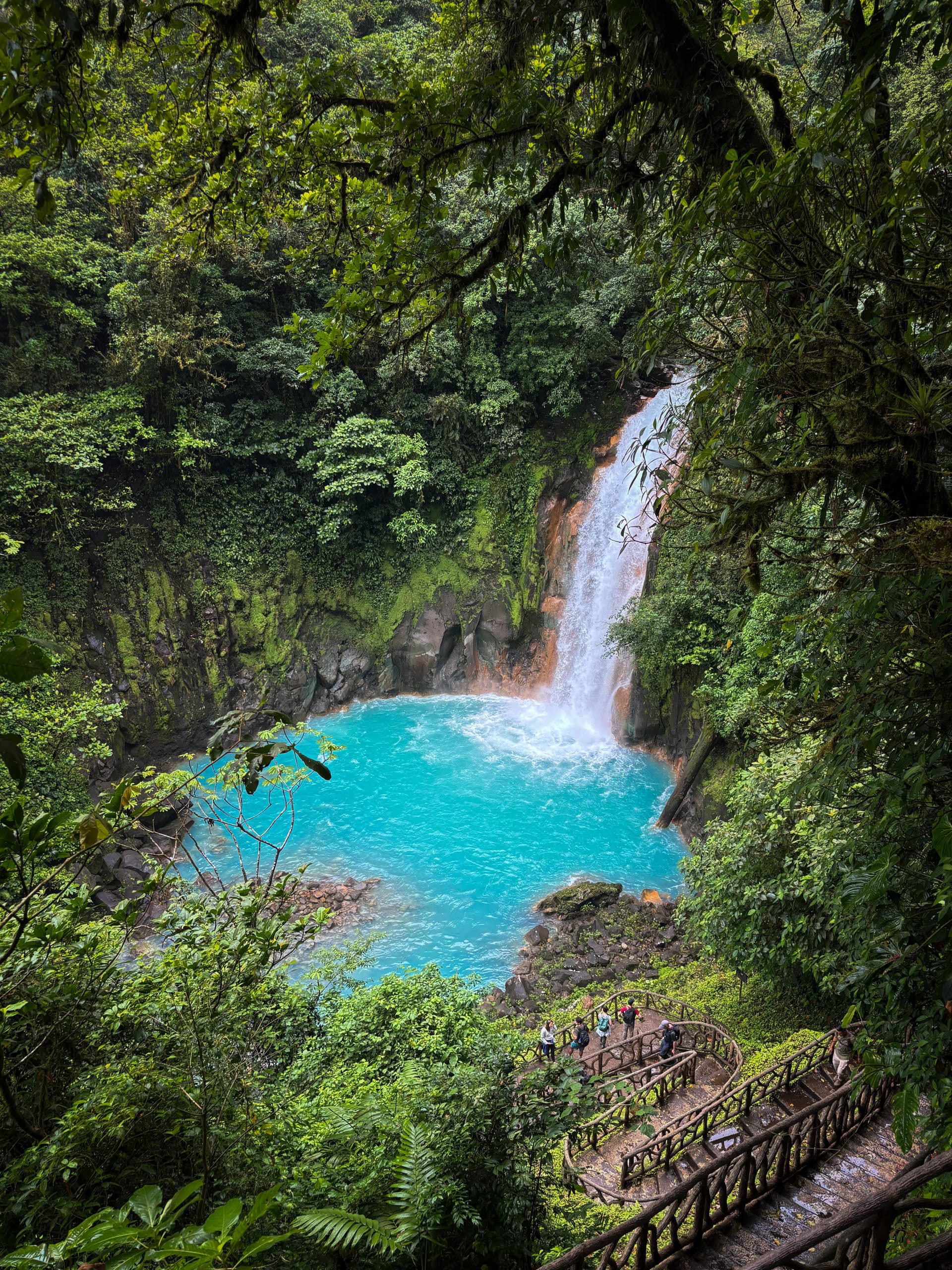
Río Celeste is one of the most photographed natural wonders in Costa Rica — a river that flows a vivid, impossible shade of turquoise through the rainforest of Tenorio Volcano National Park in northern Guanacaste. Every year, thousands of travelers plan their entire trip around visiting it. And yet, many arrive underprepared — without the right shoes, missing the best time of day, or unaware of the five distinct highlights spread along the trail. This guide covers everything you need to know to make the most of your visit.
What Makes Río Celeste Blue? The Science Behind the Color
The short answer: volcanic chemistry and light. Two perfectly clear mountain streams — Río Buenavista and Quebrada Agria — flow separately through the forest before converging inside Tenorio Volcano National Park at a point called Los Teñideros. Each river carries a suspension of fine volcanic mineral particles called aluminosilicates. When the two streams meet, those particles combine and scatter sunlight at a wavelength our eyes perceive as vivid sky-blue — an optical phenomenon called Tyndall scattering, the same physics that makes the sky blue. The color is not caused by algae, bacteria, or dye. It is entirely physical, shifting with the angle of light, particle concentration, and river flow. The most intense blue appears in late morning when direct sunlight strikes the water at a low angle. After heavy rain, the color can appear more opaque; in the dry season, it runs clearer and more vivid. Either way, the effect is unlike anything most visitors have seen before.
The Five Highlights on the Río Celeste Trail
The main loop trail at Tenorio Volcano National Park is approximately 8 kilometers round-trip and takes 3 to 4 hours at a relaxed pace. It passes five distinct points of interest:
- Los Teñideros — The confluence where both rivers merge and the water transforms from clear to turquoise in real time. One of the most extraordinary natural moments in Costa Rica.
- The Blue Lagoon (Laguna Azul) — The only swimming spot on the trail. A wide, placid pool of turquoise water, cool at around 20°C, surrounded by dense forest. Bring your swimsuit.
- El Mirador — A raised viewpoint with a panoramic view of the river canyon and rainforest canopy. On clear days, steam rising from volcanic areas is visible. One of the best photography spots on the trail.
- Los Borbollones — A section where volcanic activity causes the riverbed to bubble as if boiling from below. Swimming is prohibited here due to high temperatures. Do not enter the water.
- Río Celeste Waterfall (Catarata) — The trail's signature landmark: a 30-meter cascade of turquoise water. Access requires descending ~250 carved steps and climbing back up — completely worth it. Arrive before 10 AM to avoid crowds.
Best Time to Visit Río Celeste
Tenorio Volcano National Park is open year-round and the turquoise color is visible in all seasons. The dry season (December–April) offers clear skies, dry trails, and ideal photography light — but also peak crowds. Arrive at the park entrance by 8 AM (opening time) to have the trail largely to yourself for the first hour. The green season (May–November) is genuinely spectacular: the forest is intensely lush, the waterfall runs louder and more dramatic, and wildlife activity peaks. Morning visits during the green season are bright and often dry until mid-afternoon. Crowds are noticeably smaller. Whatever the season, visit in the morning — light is best, crowds are thinnest, and the color of the water is most photogenic before noon.
What to Pack for the Río Celeste Trail
Being prepared makes a real difference on this hike. Here is what to bring:
- Closed-toe shoes or hiking sandals with grip — the trail has tree roots, steep steps, and stream crossings. Flip-flops are genuinely dangerous.
- Swimsuit and quick-dry towel — for the Blue Lagoon, one of the highlights of the entire experience.
- Insect repellent — mosquitoes and sandflies are active near water and in the forest.
- Sunscreen — partial canopy cover means exposed sections can be intense, especially at midday.
- Rain jacket or light poncho — tropical showers can appear quickly in any season.
- At least 1.5 liters of water per person — no food or drinks are available inside the trail.
- Change of clothes and dry bag — to protect electronics near the waterfall and after the lagoon swim.
Getting There: From Guanacaste Hotels to the Park
Tenorio Volcano National Park is located near Bijagua de Upala, approximately 85 km from Liberia city center. The route follows Route 1 north toward Cañas, then Route 6 toward Upala. The final unpaved section before the park entrance is manageable with a regular sedan in the dry season; a high-clearance vehicle or 4WD is recommended during the green season. Approximate drive times from major Guanacaste hotels:
- From Liberia: 1.5–2 hours
- From Papagayo: 2–2.5 hours
- From Flamingo / Conchal: 2.5–3 hours
- From Tamarindo: 2.5–3 hours
- From Nosara: 3–3.5 hours
Park Rules and Visitor Etiquette
A few rules to be aware of before you go:
- Entrance fee: ~$18 USD adults, ~$5 USD children (subject to change — verify on arrival or book a guided tour with entrance included).
- Visitor capacity: limited to 100 people on the trail at any one time. Arrive early during peak season.
- Swimming: permitted ONLY at the designated Blue Lagoon. Prohibited at the waterfall, Los Borbollones, and all other sections.
- Drones: prohibited inside the park.
- Pets: not permitted.
- Trash: no receptacles inside the trail — carry all waste out with you.
- Trail closures: the park may close temporarily after heavy rain if conditions are unsafe. Check before departing in the green season.
Guided Tour vs Self-Drive: Which Is Better?
Both options work well, but they offer meaningfully different experiences. Self-drive gives complete flexibility — your own schedule, your own stops, full control of the day. You'll need a reliable vehicle (4WD recommended in the green season), an offline map, and comfort navigating Costa Rican roads. The limitation without a guide is context: you'll see the highlights, but you'll miss the frogs, insects, and camouflaged birds that an experienced naturalist spots immediately. A guided tour with MoonRiver Travel includes hotel pickup, round-trip transportation, a bilingual naturalist guide, and the park entrance fee. You don't manage logistics — your only job is to enjoy it. The guide explains the volcanic chemistry behind the color, identifies wildlife along the trail, and brings the park to life in a way that is genuinely enriching. For first-time visitors, a guided tour makes Río Celeste significantly more rewarding. For experienced eco-travelers on a return visit who want full flexibility, self-drive is the better call.
Book with MoonRiver
Ready to experience Nature Guide?
Private tours from Liberia, Guanacaste. Confirm in 24 h via WhatsApp.
Book This TourRío Celeste is one of those destinations that genuinely rewards preparation. Arriving early, wearing the right footwear, and understanding what you are about to see — why the water is that color, what each of the five stops on the trail is — transforms what could be a confusing day hike into an unforgettable natural experience. Whether you choose to drive yourself or book a guided tour, Tenorio Volcano National Park more than repays the effort.
Ready to explore Guanacaste?
Browse our tours and private transfers. MoonRiver Travel picks you up from any hotel in Guanacaste.